
Market & Pricing
Summer Squeeze? Don't Count on Propane Price Drops This Season
Summer Propane Prices: Don't Expect a Dip!
Executive Summary
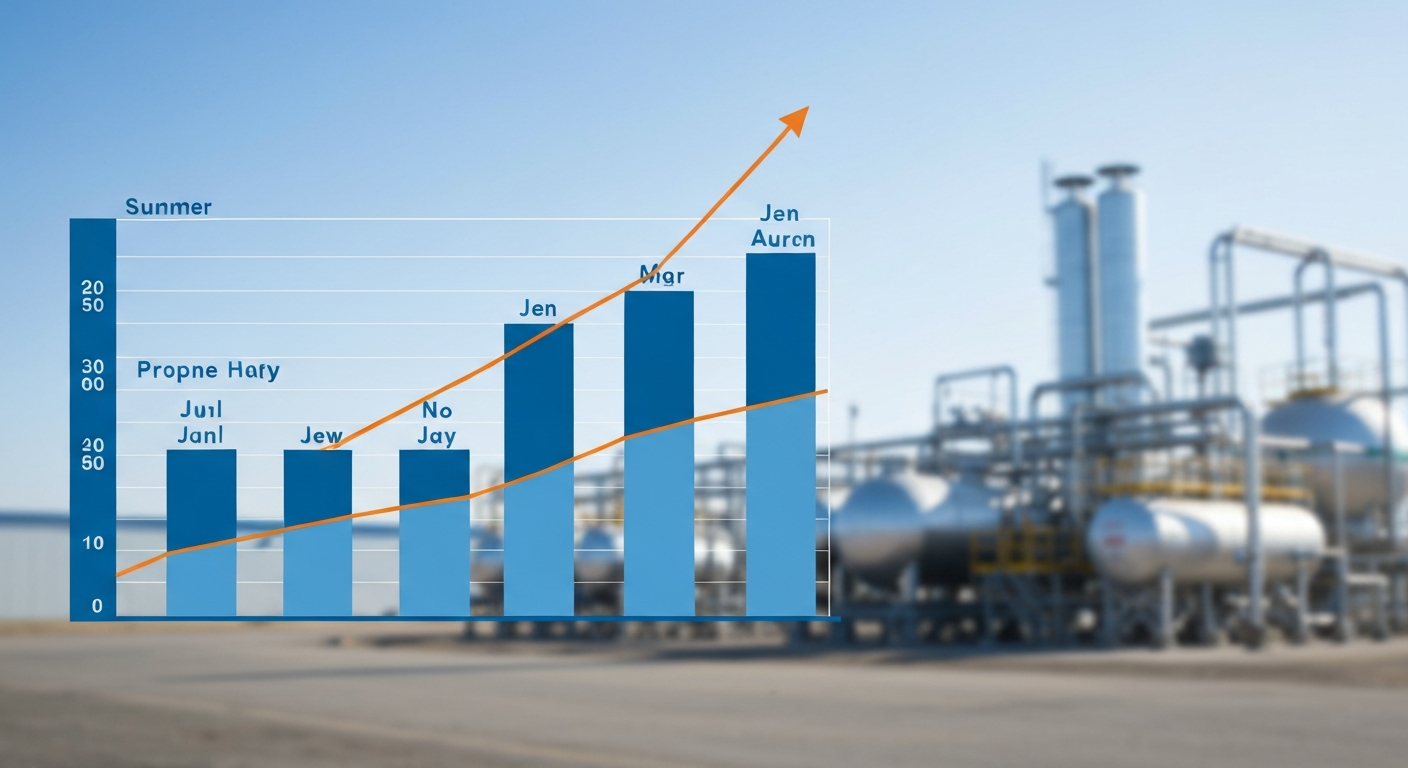
Despite lower seasonal demand, propane prices are not expected to significantly drop this summer. Strong export markets and geopolitical factors are keeping prices firm. Distributors should carefully plan inventory strategies to mitigate potential volatility and adjust customer expectations.
The Situation
Conventional wisdom suggests propane prices dip in summer due to lower heating demand. However, current market analysis from Gas Production Company and RBN Energy challenges this notion. Factors like refinery output, robust export demand, and ongoing geopolitical shifts are creating a complex pricing environment where summer price reductions are increasingly unlikely. This leaves distributors to navigate a potentially volatile market without the traditional seasonal relief.
The Facts
While warmer months typically bring lower heating demand, other critical factors are preventing significant propane price drops this summer. Gas Production Company reports that 'propane prices rarely drop in summer,' citing refinery output and strong market exports as primary influences. This contradicts the long-held assumption that summer is the ideal time for bulk purchases due to seasonal lows.
Export Demand Dominates RBN Energy further explains the U.S. propane market dynamics, emphasizing three main drivers: export economics, dock space, and storage levels. Geopolitical events, such as the 'Iran war,' have dramatically shifted export economics, leading to increased global demand for U.S. propane. This strong export pull means domestic buyers are competing with international markets, keeping prices firm. An LP Gas report echoes this sentiment, stating, 'For U.S. domestic buyers of propane, it is time to step aside if possible and let their foreign cousins have what they need.'
Storage Levels & Supply Outlook Despite historically high U.S. propane storage levels, RBN projects these will 'fall in 2026 as added dock space rebalances market.' This suggests any current surplus will be quickly absorbed by growing export capacity. Butane-Propane News' forecast indicates U.S. inventories will hover just above the five-year average through the 2026-27 winter, offering little cushion for unexpected demand spikes. Suburban Propane's stable quarterly distribution of $0.325 for Q2 2026, as reported by TipRanks.com, suggests a confident outlook on market stability despite these underlying dynamics.
Business Impact
Propane companies can no longer rely on summer for significant inventory price reductions. This necessitates a shift in purchasing strategies, potentially requiring earlier commitments or more diversified procurement. Increased global demand means tighter margins for domestic suppliers if not managed carefully. Budgeting and forecasting must account for sustained higher prices, and companies should explore options like customer budget plans to stabilize revenue and manage customer expectations, as highlighted by Gas Production Company.
Key Data Points
- Propane prices 'rarely drop in summer' (Gas Production Company).
- Global export demand, influenced by geopolitical events, is a major price driver.
- U.S. propane storage projected to fall in 2026 (RBN Energy).
- Inventories expected to remain just above five-year average through 2026-27 winter.
- Suburban Propane declared a stable Q2 2026 distribution of $0.325.
Key Takeaways
- Traditional summer propane price dips are unlikely due to strong export demand and geopolitical factors.
- Robust global demand for U.S. propane is keeping domestic prices firm.
- Propane storage levels are projected to fall in 2026, limiting future price relief.
- Companies must adjust purchasing and budgeting strategies for sustained higher prices.
Action Steps
- 1Re-evaluate summer purchasing strategies, considering earlier or staggered inventory buys.
- 2Communicate transparently with customers about pricing trends and budget plan options.
- 3Monitor global geopolitical events and export data closely for market indicators.
- 4Review hedging strategies to mitigate price volatility risks.
Competitive Advantage
Companies that adapt to this new pricing reality by optimizing inventory management and offering flexible customer payment plans will maintain customer loyalty and financial stability. Proactive communication about market conditions can build trust and differentiate businesses.
Given these market dynamics, what proactive steps are you taking to secure your summer propane supply and manage customer expectations?
Get the next one in your inbox.
Free propane industry news, twice a week. 32,000+ operators already read it.
No spam, unsubscribe anytime. We'll email you a link to confirm — that's how we keep the list real. See our privacy policy.